This is general information, not financial advice. Your circumstances are unique — always speak to a qualified mortgage broker before making financial decisions. This page may contain affiliate links. Affiliate disclosure · Terms

RAAC (Reinforced Autoclaved Aerated Concrete) entered mainstream public consciousness in 2023 when the Department for Education announced that hundreds of school buildings might need immediate evacuation or structural support. But RAAC is not confined to schools. It was used in residential housing, commercial buildings, and public sector construction throughout the 1950s, 1960s, and 1970s — and some of those buildings are now facing the same structural concerns.
What Is RAAC?
Reinforced Autoclaved Aerated Concrete is a form of precast concrete containing air bubbles — hence "aerated." It is much lighter than standard concrete and was relatively cheap and quick to produce, making it popular for post-war reconstruction across the public sector and social housing.
It was manufactured into planks — typically around 600mm wide and varying in length — which were used as roof panels, floor panels, and in some cases wall elements. The "reinforced" element refers to steel bars running through the planks, though the reinforcement specification is generally lower than in standard reinforced concrete.
The problem is that RAAC is relatively porous, which allows moisture to penetrate more easily than denser concrete. Over time, this causes the steel reinforcement to corrode. Once the steel corrodes sufficiently, the structural integrity of the plank is compromised — and because RAAC is brittle rather than ductile, it can fail suddenly rather than showing warning signs before collapse.
Why RAAC Has Become a Crisis
RAAC was designed and marketed with a lifespan of approximately 30 years. Most RAAC-containing buildings in the UK were constructed between 1955 and 1980, meaning that even the youngest RAAC buildings are now over 40 years beyond their design life.
The structural failures seen in schools in 2023 — some of which collapsed without warning — were the trigger for the national assessment programme. But RAAC buildings across all sectors have been quietly deteriorating for years, with many building managers and owners unaware of what their roofs or floors were made from.
The fundamental issue is that RAAC cannot be economically repaired in most cases. Strengthening or replacing individual planks is possible in some situations, but where the plank is structural and access is limited, the cost approaches replacement. And any repair relies on identifying the affected planks — which in many cases requires removing finishes to inspect the concrete directly.
RAAC can be hidden
In many residential properties, RAAC roof planks are concealed beneath screed, insulation, and roof coverings externally, and behind plasterboard or ceilings internally. Properties built in the relevant period may contain RAAC without the owner's knowledge. Identification requires specialist investigation.
Which Properties Are Likely to Contain RAAC?
RAAC was primarily used in public sector and social housing construction, particularly:
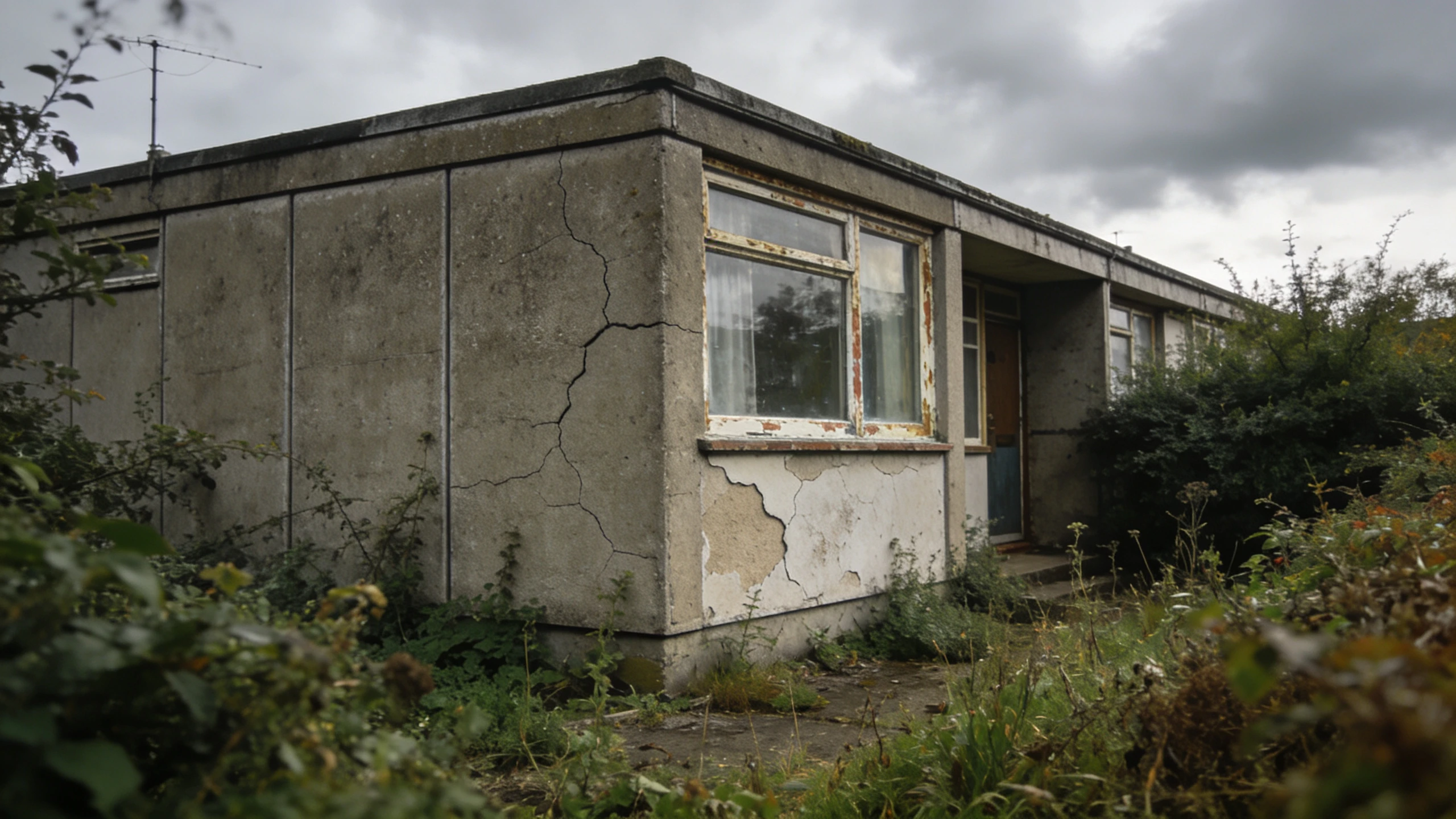
Local authority housing (council estates): Many council houses and flats built from the 1950s through the early 1980s used RAAC roof panels and floor planks. Flat-roofed bungalows and low-rise blocks are particularly associated with RAAC roof construction.
Former council properties now in private ownership: The Right to Buy scheme, which began in 1980, meant that many council properties passed into private ownership. Buyers and subsequent purchasers may have no idea that their home contains RAAC.
Housing association properties: Some housing associations inherited council stock or built using similar methods in the same period.
Less commonly, private residential: Some private developers used RAAC in the same period, though it was less common than in public sector construction.
Key construction clues:
- Flat or very shallow-pitched roofs on properties built 1955-1980
- Slab construction on floor elements
- Local authority or social housing of this vintage
- Properties in areas that were subject to intensive post-war rebuilding programmes
Identifying RAAC in Your Property
RAAC identification requires specialist investigation. The steps typically involve:
- Reviewing building records — if the property was originally local authority-owned, planning and building records may indicate the construction method
- Visual inspection of accessible roof or floor voids — RAAC planks have a distinctive appearance: lightweight, with a porous texture, and often showing the regular pattern of the reinforcement bars or exposed ends
- Physical testing — a structural engineer may take core samples of concrete for laboratory analysis to confirm whether it is RAAC
- Specialist RAAC survey — a growing number of structural engineers now offer RAAC-specific surveys, following the 2023 crisis
Cost of a specialist RAAC survey: Typically £500-1,500 for a residential property, depending on access requirements and the complexity of the investigation.
Why RAAC Properties Are Currently Unmortgageable
Mortgage lenders assess the property they are lending against as security. RAAC properties present two problems that make this security unacceptable:
Structural risk: RAAC beyond its design life can fail suddenly. Lenders cannot lend against a building that may be structurally unsafe — and cannot meaningfully assess the risk given that inspections are limited and failure can occur without visible warning signs.
Marketability: Even if a RAAC property is currently stable, its prospects for future resale are severely limited. The lender needs to be confident they could sell the property to recover their debt if necessary. A property that no buyer can mortgage has a very limited market.
At the time of writing (early 2026), no mainstream mortgage lenders and very few specialist lenders are actively offering mortgages on properties confirmed to contain RAAC. Our construction lender checker can confirm the current lending position for RAAC properties. The situation may evolve as government guidance develops and remediation pathways emerge, but currently the practical position for most RAAC property owners is that conventional mortgaging is not available.
Current Options for RAAC Property Owners and Buyers
Cash Sale
The most straightforward exit for an owner of a RAAC property is a cash sale. Cash buyers — including investor buyers and property purchasing companies — are not subject to mortgage lender requirements and can proceed where a mortgaged buyer cannot.
Cash buyers will discount heavily for RAAC properties, typically purchasing at 50-70% of the open market value of an equivalent non-RAAC property, reflecting the structural uncertainty and the cost or risk of dealing with the issue.
Points to consider: Some cash buying companies (the "we buy any home" sector) make their profit on the discount. It is worth approaching multiple buyers and being realistic about what a genuine arms-length cash sale in the current market would achieve for a RAAC property.
Demolition and Redevelopment
Where the site has sufficient value and the property is detached or part of a small block, demolition and redevelopment may be the most economically logical solution. A new building on the site would have full mortgage availability and a modern design life.
Practical considerations:
- Planning permission is required for demolition and new build
- Infrastructure connections (utilities, drainage) usually can be retained
- The cost of demolition plus new build must be weighed against the land value plus potential sale price
- For owners who cannot afford to fund this themselves, joint venture arrangements with developers are sometimes possible — the developer funds the works in exchange for a share of the end value
Propped or Supported RAAC
In some situations, structural engineers can design a temporary or permanent support system that props the RAAC planks to prevent collapse. This is more common in commercial and public sector buildings than residential. It does not restore mortgageability but may allow continued occupation while longer-term decisions are made.
Government Programmes
The government's response to the RAAC crisis has focused primarily on the public sector — schools and NHS buildings — but pressure is growing for a residential programme to be established. At the time of writing, no specific grant or remediation scheme exists for residential RAAC owners, though this may change.
Sell your property
Need to sell a RAAC property?
SellTo helps UK homeowners sell any property quickly — cash purchase or auction, no fees to you, and a straightforward process. Get a free, no-obligation offer.
Get a free cash offer →We may earn a commission if you use this service. Affiliate disclosure
Owners of former council properties with RAAC may wish to contact their local authority, which has records of the original construction and may have access to information about developing support programmes.
Check with your local authority
If your property was originally built as council housing, your local authority may have records of the construction method and may be tracking RAAC properties in their area. They should be your first port of call for information about whether any support programmes exist or are being developed.
Insurance Implications
Buildings insurance for confirmed RAAC properties is very difficult to obtain. Insurers face the same problem as lenders — the structural risk is uncertain and potentially severe, and the property has limited market value.
Some specialist insurers will offer cover, but typically:
- At significantly higher premiums
- With large excesses (£5,000-25,000+) for structural claims
- With exclusions for collapse of RAAC elements
It is essential to disclose the presence of RAAC to your insurer. Failure to disclose a material fact may invalidate any claim.
What to Do if You Suspect Your Property Contains RAAC
- Commission a specialist RAAC survey from a chartered structural engineer — this is the essential first step
- Review building records — your local authority planning department or building control may have records
- Do not panic about immediate safety — most RAAC buildings are not in imminent danger, but the uncertainty justifies investigation
- Contact your mortgage lender if you have one — they need to be aware, and some may have specific procedures for RAAC properties in their loan book
- Contact your insurer — disclose the situation and confirm whether your cover remains valid
- Seek legal advice if you bought the property recently without RAAC being disclosed — there may be grounds for a claim against the seller if RAAC was known or should have been known at the time of sale
- Explore the options discussed above — cash sale, demolition/redevelopment, and government programmes are the most realistic avenues
The Selling Position
If you need to sell a RAAC property, honest disclosure is both legally required and practically important. Attempting to conceal the presence of RAAC from buyers would expose you to future legal claims and is likely to be discovered during the buyer's survey in any event.
With realistic pricing and upfront disclosure, RAAC properties can be sold — primarily to cash investors who will either demolish and redevelop, or take a long-term view on government remediation programmes. The market is limited, so patience and realistic expectations are needed.

Our exclusive broker partner
Create Finance — for non-standard construction or RAAC
Create Finance is authorised and regulated by the FCA — Unmortgageable is not. We earn a referral fee from Create Finance only if your mortgage completes through them. This never affects what you pay or what advice you receive.

Unmortgageable is not FCA-authorised. Create Finance is — verify them independently on the FCA Register. See our affiliate disclosure.
This is educational content, not financial advice. The situation with RAAC is evolving and the information in this guide reflects the position as of early 2026. Speak to a qualified structural engineer and a specialist mortgage broker for advice specific to your property and circumstances. Legal advice is also important if you have recently purchased a RAAC property.
Find out if the property is the problem
Quick check for the construction, lease, cladding, and title issues that get mortgage applications declined — before you spend on a survey.
Get startedRelated reading
Concrete Construction Mortgages (Wimpey No-Fines, Airey, etc.)
Getting a UK mortgage on a concrete construction home — Wimpey No-Fines, Airey, Reema, Cornish Unit, and more. PRC certificates, remediation, and lending options.
Derelict and Uninhabitable Properties: Your Finance and Sale Options
What makes a property uninhabitable for mortgage purposes, and what are your options? Bridging finance, auction, cash buyers, and planning considerations explained.

Structural Defects and Mortgages: Wall Ties, Cracking, and Movement
How structural defects like wall tie failure, cracking, and building movement affect UK mortgages. Survey red flags, repair costs, and which lenders accept repaired properties.

Bridging Loans Explained: When They Make Sense
UK guide to bridging loans. When they make sense, what they cost (0.5-1.5% monthly), the risks involved, and when to consider alternatives instead.
Not sure about your mortgage options?
Find out your options — whether it's your circumstances or your property holding you back. Free, no judgement, no cold calls.
This page is educational content, not financial advice or a personal recommendation. Unmortgageable is not FCA-authorised. Any broker or lender we link to is separately regulated — verify them on the FCA Register before engaging. See our affiliate disclosure.